


An AI Research Assistant That Shows Its Working.
Ask questions about markets, companies and economic data in plain language, and get explanations, summaries and comparisons linked to the data behind them.
Ask questions about markets, companies and economic data in plain language, and get explanations, summaries and comparisons linked to the data behind them.
The assistant is designed to sit across every Quantzivo AI module. Ask it to explain a concept, pull together data, summarize recent coverage or compare companies, and it responds with the reasoning and the sources it used, so you can check them.
 In development

Product status: Quantzivo AI is in development. Features described here reflect the planned scope and may change before release.
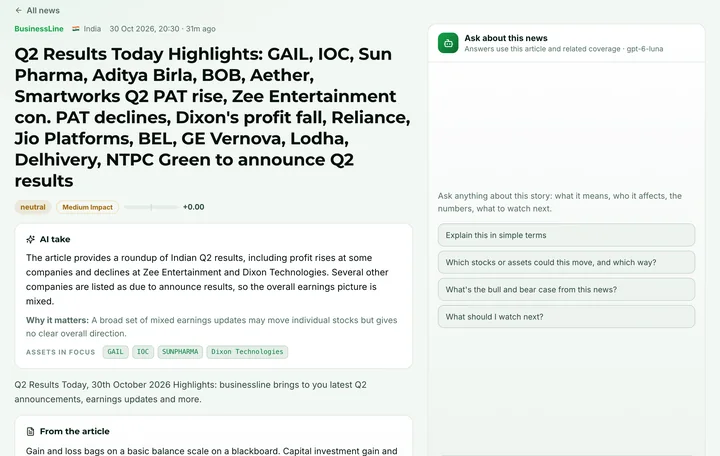
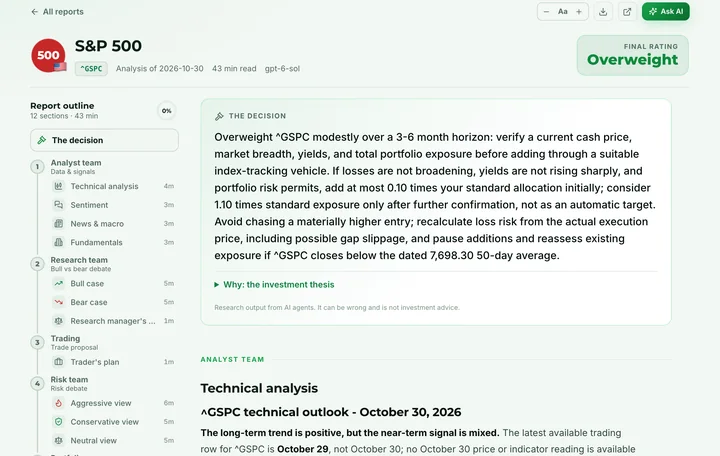


Ask a research question the way you would ask a colleague, without learning a query language.

Pull up the right series, filter by period and build a quick table or chart from a request.

Plain-language explanations of terms, ratios and methods, pitched at your level.

Condense recent news, releases or statements for a watchlist into a short, source-linked brief.

Understand what an indicator reading measures and the conditions in which it tends to mislead.

Walk through what changed between periods and which line items drove the change.

Compare companies, sectors or periods on the metrics you choose, with the method spelled out.

Facts come with links to the data, filing, release or article they were drawn from.
Good prompts ask the assistant to explain, summarize, compare or explore. These examples show the range across Quantzivo AI's modules.
"Explain free cash flow and why it can differ from net income, using a simple example."

"What does an RSI reading above 70 actually measure, and when has it been a poor guide?"
"Summarize how this company's operating margin changed over five fiscal years and which costs drove it."
"Compare debt-to-equity for these three companies and explain what might account for the differences."

"List this week's stories on my watchlist that mention guidance changes, with a link to each source."

"What changed in the wording of the latest central bank statement compared with the previous one?"

If a request is ambiguous, such as which period or which measure, the assistant is designed to ask or state its assumption.
It draws on data and documents available in the platform rather than relying only on what the model remembers.

The answer describes the figures, periods and calculations used, so you can follow the reasoning.
Sources are linked, and gaps or uncertainty in the data are stated rather than smoothed over.
Some requests fall outside what a research and education tool should answer. In those cases the assistant is designed to decline clearly and offer something useful instead.
| If you ask… | The assistant won't… | It can instead… |
|---|---|---|
| "Should I buy this stock?" | Make buy, sell or hold recommendations | Explain the company's fundamentals, recent news and how it compares with peers |
| "Where will this price be next month?" | Predict prices, targets or market direction | Describe historical volatility and what has driven past moves |
| "Give me a strategy that makes money." | Promise returns or supply ready-made trading signals | Explain how to frame a hypothesis and test it in Quantzivo Studio |
| "How should I invest my savings?" | Give personalized financial, tax or investment advice | Explain general concepts such as diversification and suggest speaking to a qualified advisor |
| "Place this trade for me." | Execute trades or connect to a brokerage account | Help you research the instrument; Studio paper trading is simulated only |

AI can be wrong. The assistant can misread data, confuse similar companies or state errors confidently. Treat answers as a starting point, follow the source links and verify any figure you rely on.

Name the company, the metric and the period. Vague questions get vague answers.
If an answer has no source, ask where the figure came from before using it.

Spot-check key figures against the statements, releases or articles linked in the answer.
Request early access to the assistant, or book a demo conversation to show us the research questions you would ask it first.

 Macro Intelligence