


Financial News Intelligence, Summarized and Source-Linked.
Follow headlines, market news and corporate announcements by topic and watchlist, with AI summaries that always point back to the original story.
Follow headlines, market news and corporate announcements by topic and watchlist, with AI summaries that always point back to the original story.
Financial news arrives as a constant stream of headlines, repeats and announcements. The news module is designed to sort that stream by topic and by the companies you follow, add a short AI summary to each item and keep a clear link to the original source.
 In development

Product status: Quantzivo AI is in development. Features described here reflect the planned scope and may change before release.
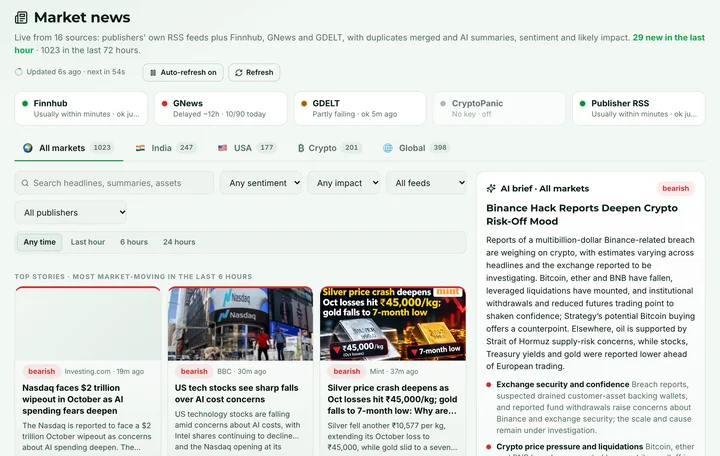
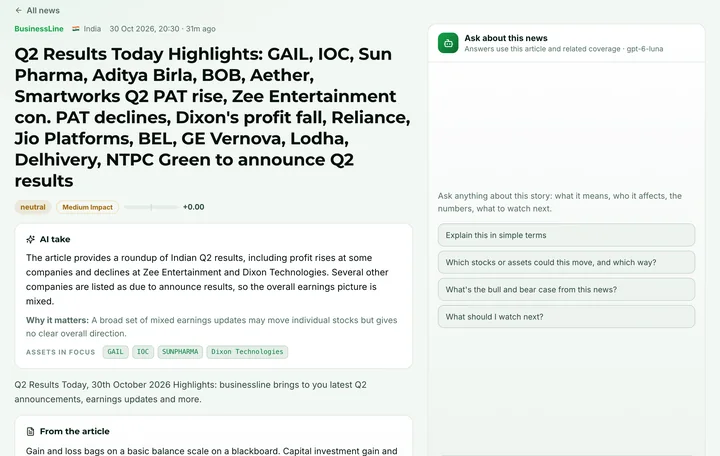


A single feed of financial headlines, grouped so repeated coverage of the same story is easier to spot.

Broader market and sector stories alongside company news, so you see the backdrop as well as the detail.

Results, guidance updates, dividends, buybacks, management changes and deals, tagged by type.

One or two sentences on what was reported, written to describe the story rather than to judge it.

Each item tagged with topics, companies and sectors so you can filter the feed in a few clicks.

Every summary carries a link to the original story, so the source, not the summary, is the reference.
Each item is stored with its headline, publisher, publication time and original link.
The AI writes a short summary from the text it can access, focusing on what was reported.
Topics, companies and sectors are tagged, and near-duplicate stories are grouped together.
The summary is shown with its source and time, and one click opens the original for the full context.
Planned topic tags cover the kinds of stories researchers most often look for. Combine them with watchlists and date ranges to narrow the feed.

Show only earnings stories, or only policy news, when that is the question you are working on.

Limit the feed to the companies and sectors in a watchlist so relevant stories are not buried.

Look back at the coverage around a specific period, such as the weeks before and after a results release.
Summaries save time, but they are a compression of someone else's reporting. These are the main ways they fall short, and what to do about it.
| Limitation | Why it happens | What to do |
|---|---|---|
| Lost nuance | A short summary drops qualifications, conditions and context from the full article. | Open the source for anything you plan to rely on. |
| Factual errors | Language models can misread figures, confuse companies or state something the article did not say. | Check key numbers and names against the original. |
| Partial access | If only a headline or excerpt is available, the summary can only reflect that portion. | Treat summaries of short excerpts as headlines, not full stories. |
| Timing | Stories are updated and corrected after publication; a summary reflects the version it was written from. | Note the timestamp and check the source for updates. |
| Source framing | Summaries inherit the angle and emphasis of the original reporting. | Compare coverage of the same event from more than one source. |
| Misplaced tags | Automatic topic and company tags can be wrong, especially for companies with similar names. | Use tags to filter, then confirm relevance by reading. |

News is context, not a recommendation. Summaries describe what was reported. They are not investment advice or a judgment on whether to buy or sell anything, and the original source should be treated as the authoritative version.

A headline about margins means more when the margin history is one click away. The news module is designed to share context with the rest of Quantzivo AI.
 See the tone of coverage over time in Sentiment AnalysisCheck a results story against the reported figures in Fundamental ResearchRead policy news next to the data in Macro IntelligenceAsk the AI assistant to summarize a week of stories for a watchlist
Request early access to the news intelligence module, or see how it connects to sentiment, fundamentals and macro research across Quantzivo AI.